Navigating U.S. Immigration Law: Essential Insights
Welcome to the Gorostiaga Law Firm Blog!
At Gorostiaga Law Firm, we believe in empowering our clients and the community through knowledge and resources. Our blog is dedicated to sharing valuable insights on immigration law, personal stories, client success, and updates in the legal landscape.

Work Visa Options Explained: Which One Fits Your Situation?
Work Visa Options Explained: Which U.S. Work Visa Fits Your Situation?
Understanding U.S. work visas can feel overwhelming. This guide breaks down the main options, clarifies temporary versus permanent paths, and explains basic eligibility and application steps so you can identify the visa that matches your goals. Immigration law can be complex — accurate guidance helps you make smart decisions at every step. Below we cover the principal visa categories, what they require, and how to choose the right route for your situation.
What Are the Main Types of U.S. Work Visas?
Work visas in the U.S. generally fall into two categories: temporary nonimmigrant work visas and permanent employment-based green cards. Each serves a different purpose and follows its own application path.
How Do Temporary Nonimmigrant Work Visas Differ from Permanent Employment-Based Green Cards?

Temporary nonimmigrant visas — for example, H-1B and L-1 — let you work in the U.S. for a limited period, usually with employer sponsorship and, in some cases, an annual cap. Permanent employment-based green cards create a path to indefinite residence and work authorization. Green card processes are typically longer and may require labor certification and additional documentation, while some categories allow self-petitioning.
Which U.S. Government Agencies Oversee Work Visa Applications?
Several federal agencies manage parts of the process. U.S. Citizenship and Immigration Services (USCIS) adjudicates petitions and applications. The Department of Labor (DOL) handles labor certification and wage protections to ensure U.S. workers aren’t disadvantaged. The Department of State issues visas through embassies and consulates, and other agencies may be involved depending on the case.
What Are the Eligibility Requirements for Popular Temporary Work Visas?
Each temporary visa type has its own eligibility criteria. Below are the basic rules for some of the most common categories.
What Are the H-1B Visa Requirements for Specialty Occupations?
The H-1B serves specialty occupations that demand theoretical or technical expertise. To qualify you need a job offer from a U.S. employer, a relevant bachelor’s degree or higher (or its equivalent), and proof that the role requires specialized knowledge. The employer must also file a Labor Condition Application (LCA) with the DOL to certify wages and working conditions meet U.S. labor standards.
Who Qualifies for the L-1 Intra-Company Transferee Visa?
The L-1 is for employees of multinational companies transferring to a U.S. office. L-1A is for executives and managers; L-1B is for employees with specialized knowledge. Applicants must have worked for the company for at least one continuous year within the last three years and be coming to the U.S. to fill a qualifying managerial, executive, or specialized role.
How Do Permanent Employment-Based Green Cards Work?
Employment-based green cards let foreign nationals live and work in the U.S. on a permanent basis. The typical process involves multiple steps — employer sponsorship, labor certification, petition filing, and adjustment of status or consular processing — though some categories permit self-petitioning.
What Are the Requirements for the EB-2 Visa and National Interest Waiver?
EB-2 targets professionals with advanced degrees or those with exceptional ability. Most EB-2 petitions require an employer and a labor certification. The National Interest Waiver (NIW) lets certain applicants self-petition if they can show their work benefits the U.S. national interest, allowing them to bypass employer sponsorship and labor certification when the evidence supports the waiver.
In practice, the NIW can shorten or simplify the green card path for individuals whose work demonstrably serves U.S. interests.
EB-2 Visa & National Interest Waiver Explained
The EB-2 category normally requires labor certification from the Department of Labor. The National Interest Waiver (NIW) permits qualified individuals to request a waiver of that requirement when their proposed work substantially benefits the United States, allowing self-petitioning without an employer sponsor.
Attracting the best and the brightest: A critique of the current US immigration system, S Yale-Loehr, 2010
How Does the EB-5 Immigrant Investor Program Operate?
The EB-5 Immigrant Investor Program provides permanent residency to foreign investors who invest a minimum of $1,050,000 (or $800,000 in targeted employment areas, including rural or high-unemployment areas) in a U.S. enterprise that creates at least ten full-time jobs for U.S. workers. The program aims to stimulate economic growth through capital investment and job creation.
Historically, EB-5 has driven significant foreign investment and local job creation across many U.S. communities.
EB-5 Immigrant Investor Program Overview
The EB-5 Program was created in 1990 to attract foreign direct investment that generates jobs and economic activity in U.S. communities. Over time it has channeled billions in investment and supported the creation of thousands of jobs.
Revitalizing Urban America Through the EB-5 Immigrant Investor Program, 2020
What Is the Step-by-Step Process to Apply for a U.S. Work Visa?
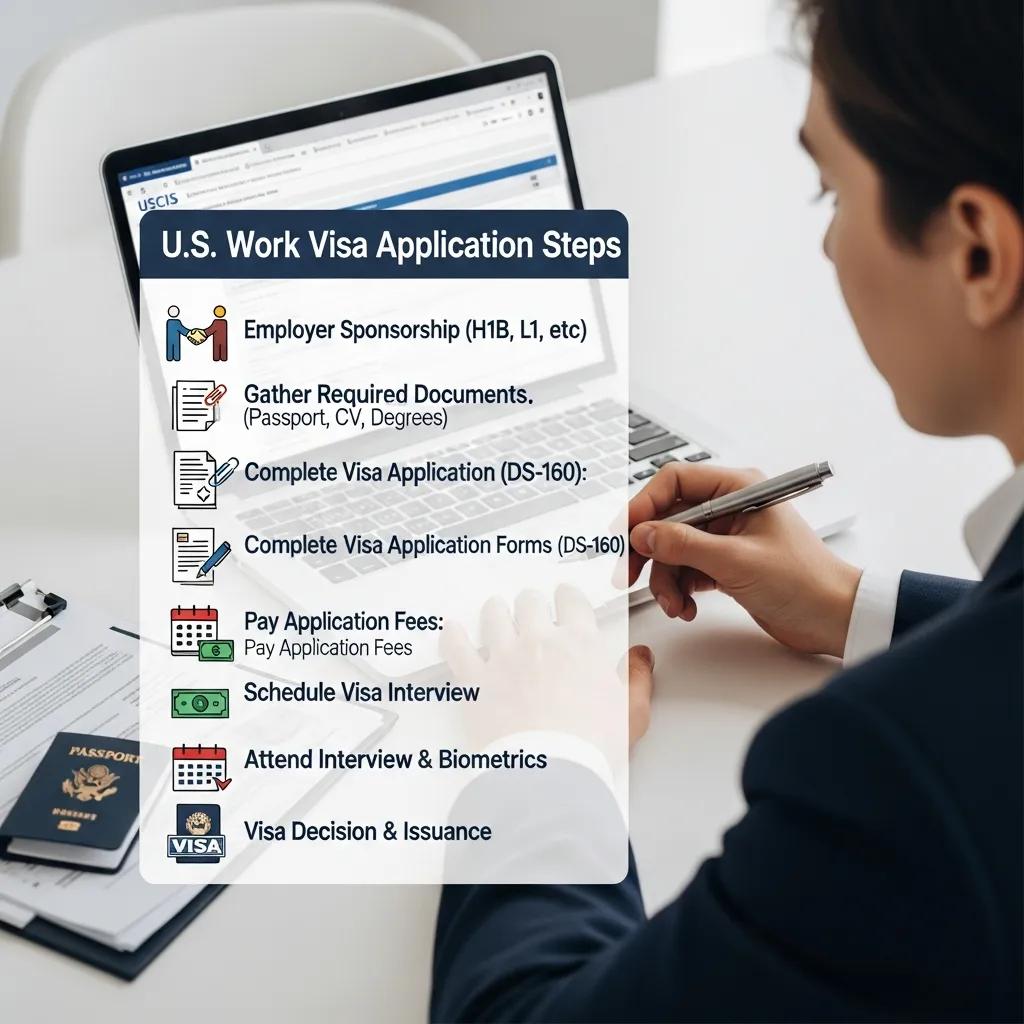
Application steps vary by visa type, but common milestones include petition filing, documentation gathering, possible labor certification, visa issuance, and arrival in the U.S. Timelines and exact procedures depend on the specific category and whether you apply from inside or outside the United States.
What Are the Employer Sponsorship and Labor Certification Requirements?
Many work visas require an employer to sponsor the foreign worker by filing a petition with USCIS. Where labor certification is necessary, the employer must demonstrate there are no qualified U.S. workers for the role, usually through a recruitment process and submission of an LCA to the Department of Labor.
How Long Do Visa Caps, Processing Times, and Appeals Typically Take?
Caps and processing times can affect your timeline. For example, H-1B petitions are subject to an annual cap and are generally filed during a specific window beginning in early April. Processing ranges from weeks to months depending on the visa, USCIS workload, and the applicant’s country of origin. If a petition is denied, you may have options to appeal or file motions to reopen or reconsider, which can extend the process.
How Can You Choose the Right Work Visa for Your Situation?
Choosing the right visa requires matching your qualifications, the job offer, and your long-term goals to the visa’s purpose and requirements.
What Are the Key Differences Between Temporary and Permanent Work Visas?
Temporary visas authorize limited-duration employment and often require employer sponsorship; some are capped each year. Permanent visas aim to provide ongoing residency and typically involve more steps, like labor certification and priority date tracking. Your career plans and family goals usually determine which route makes sense.
Which Work Visa Fits Common Professional Profiles?
Different professions tend to align with particular visas. IT and technical roles often fit H-1B. Multinational executives and managers may qualify for L-1. Healthcare professionals and advanced-degree holders frequently pursue EB-2, with NIW as an option for those whose work serves national interests.
What Common Challenges Arise in Work Visa Applications and How Can Gorostiaga Law Firm Assist?
The application process can present hurdles: complex documentation, strict timelines, visa caps, and nuanced eligibility requirements. Missing paperwork or missteps can cause delays or denials. Ready to discuss your case? Contact us today.
How Does Gorostiaga Law Firm Support Clients Through Complex Visa Processes?
Gorostiaga Law Firm, PLLC focuses on business immigration and guides clients through each stage of the visa process. Our multilingual team (English, Spanish, Portuguese, Hindi, Gujarati) provides personalized strategies that reflect your circumstances and helps you avoid common pitfalls, including complex areas like asylum and refugee law and DACA.
What Are Typical Issues with Visa Caps and Documentation?
Frequently encountered issues include hitting annual visa caps, incomplete or inconsistent documentation, and missed filing windows. Gorostiaga Law Firm helps clients assemble accurate files, track deadlines, and choose the most appropriate filing strategy to improve the chance of a favorable outcome. Learn more about our team and approach.
Frequently Asked Questions
What is the difference between a work visa and a green card?
A work visa allows temporary employment in the U.S. for a specified employer and period. A green card grants permanent residency and unrestricted work authorization, and can be a path to U.S. citizenship and naturalization. Visas usually require employer sponsorship and have specific limits; green cards can come from employment, family ties, investment, or other qualified categories. Your long-term plans determine which path is right.
Can I change employers while on a work visa?
Yes, but most work visas are employer-specific. Changing employers typically requires the new employer to file a petition on your behalf. For example, an H-1B transfer involves a new petition and usually a new LCA. Consult an immigration attorney before switching to ensure your status remains protected.
What happens if my work visa application is denied?
If an application is denied you'll receive a notice explaining the reasons. Depending on the case, you may be able to appeal, file a motion to reopen, or submit a new application with corrected or additional evidence. Reviewing the denial with an attorney helps identify the best next steps.
Are there any work visas for entrepreneurs or self-employed individuals?
Yes. Options include the E-2 Treaty Investor visa (for nationals of qualifying treaty countries who make a substantial investment and run a business) and the EB-5 Immigrant Investor Program (which leads to permanent residency with a qualifying investment that creates jobs). Each has specific requirements and suitability depends on your nationality and business plan.
How can I expedite my work visa application?
Some visas offer premium processing for an additional fee (for example, certain H-1B petitions), which yields a faster USCIS response—typically within 15 calendar days. Beyond that, submitting a complete, well-documented petition is the best way to avoid delays. An attorney can advise whether premium processing or another strategy applies to your case.
What are the consequences of overstaying a work visa?
Overstaying can have serious consequences. Staying more than 180 days but less than one year can trigger a three-year bar from re-entry; overstaying more than one year can lead to a ten-year bar. It’s important to maintain lawful status and seek legal help if you’re at risk of overstaying.

Ready to Begin Your Immigration Journey?
Let Us Guide You to Success.
Comprehensive Case
Management:
From start to finish, we handle all paperwork, deadlines, communication with U.S. immigration authorities.
Transparent
and
Clear Guidance:
Immigration processes are complex, but we make it simple by guiding you every step of the way.
Expert Guidance for Immigration Success:
At Gorostiaga Law Firm, we go beyond paperwork, taking time to understand your story, needs, and goals.
Why Choose Us?
At Gorostiaga Law Firm, we’re more than just attorneys—we’re dedicated advocates in the complex world of U.S. immigration. With extensive experience, a strong track record, and a personal approach, we deliver solutions tailored to your needs, from family sponsorships to employment visas and asylum cases.
Our multilingual team ensures clear communication and support in English, Spanish, Portuguese, Hindi, and Gujarati.
Proven Expertise in U.S. Immigration:
Our firm brings extensive experience in immigration law and is up-to-date with the latest regulations.
Why Choose Us?
At Gorostiaga Law Firm, we’re more than just attorneys—we’re dedicated advocates in the complex world of U.S. immigration. With extensive experience, a strong track record, and a personal approach, we deliver solutions tailored to your needs, from family sponsorships to employment visas and asylum cases.
Proven Expertise in U.S. Immigration:
Our firm brings extensive experience in immigration law and is up-to-date with the latest regulations.
Comprehensive Case Management:
From start to finish, we handle all paperwork, deadlines, communication with U.S. immigration authorities.
Transparent
and
Clear Guidance:
Immigration processes are complex, but we make it simple by guiding you every step of the way.
Expert Guidance for Immigration Success:
At Gorostiaga Law Firm, we go beyond paperwork, taking time to understand your story, needs, and goals.
PRACTICE AREAS
Comprehensive Immigration Support
At Gorostiaga Law, we pride ourselves on delivering the best legal defense services to
our clients. Contact us today to see how we can assist you with your legal needs.

Family Immigration
At Gorostiaga Law, we specialize in bringing families together through comprehensive immigration services. From visas to green cards, we provide compassionate guidance to ensure a smooth journey for you and your loved ones.

Business Immigration
Our firm supports businesses in navigating the complexities of immigration law. We help secure work visas and employment-based green cards, facilitating the growth and success of your enterprise in the U.S.
The Immigration Process Explained
Immigration Law in the U.S.
Navigating the Complexities of U.S. Immigration
Immigration law in the United States governs the process by which individuals can enter, stay, and become citizens. It encompasses a variety of pathways, including family-sponsored immigration, employment-based visas, asylum claims, and naturalization processes. The legal landscape is complex and constantly evolving, requiring expertise to navigate effectively.
At Gorostiaga Law, we provide tailored legal guidance to help individuals and families understand their rights and options, ensuring compliance with all applicable regulations and facilitating a smoother immigration journey.
For more detailed insights, please contact us or explore our services.

ABOUT US
We Fight for justice We are always ready.
Founded on principles of dedication, integrity, and compassion, Gorostiaga Law is committed to providing top-tier immigration and civil law services across New York, New Jersey, and Pennsylvania.
Led by Attorney Virginia Gorostiaga, our firm offers personalized legal guidance with a client-first approach. With extensive experience and a multilingual team, we strive to make complex legal matters approachable and manageable, empowering clients to navigate their legal journeys with confidence.
Contact us to learn more about how we can assist you in your pursuit of justice. We are here to offer support, expert advice, and a robust defense every step of the way.

Expert Advice
Receive expert legal advice tailored to your needs, ensuring informed decisions and effective solutions for your legal challenges.

Legal Defense
We provide strong and strategic legal
defense to protect your rights and achieve the best possible outcome for your case.

99% case win
With a 99% case win rate, we are dedicated to providing effective legal
defense to achieve the best possible outcomes for our clients.

Solutions Built Around Your Needs
From complex cases to personal guidance, Gorostiaga Law Firm is your trusted partner in creating a secure future.
Testimonials
"My husband and I had a great experience with Virginia and her team. Members of the team are fluent in spanish- As a spanish speaking person I really appreciate how easy that made it to understand and follow the process even better. Anytime we had a question or concern they were very easy to reach and always made us feel very comfortable. 100% would recommend to work with them, you won’t regret it!"
- Maria Jose Meneses Meza

"I would recommend all my friends and family to Gorostiaga Law. Virginia is effortless at what she does and genuine lawyer who does things the right way from day one. Thank you for all your time you put on my case Virginia. Take care and hopefully I come back to seek for your legal advise soon."
- Rahin Ahmed
"Ms Gorostiaga is a conscientious dedicated judicious attorney. Ms Virginia Gorostiaga treats each of her clients with a level of respect and compassion that makes you feel valued and understood and lets you know that you will be treated with the utmost professionalism and dedication. I hope one day that Ms Gorostiaga will be more than my attorney, she will be a trusted faithful lifelong friend! I am trusting her with my life and my legacy"
- Edel Quinn
Our Dedicated Immigration Services in New Jersey
At Gorostiaga Law, we are dedicated to guiding you through the complexities of immigration law with compassion and expertise.
Our services include:
Reuniting families is at the heart of what we do. We assist with family petitions, fiancé visas, and other processes to bring your loved ones closer, providing compassionate guidance every step of the way.
Our firm supports businesses and professionals navigating the complexities of immigration law. We help secure work visas and employment-based green cards, facilitating growth and long-term success.
Facing removal proceedings can be daunting, but our experienced team is here to protect your rights and build a strong defense to help you remain in the U.S.
Citizenship and Naturalization
From permanent residency to citizenship, we simplify the naturalization process and ensure you meet all requirements for becoming a U.S. citizen.
Deferred Action for Childhood Arrivals (DACA)
We assist eligible individuals brought to the U.S. as children with applying for or renewing their DACA status, helping secure their futures and remain lawfully in the country.
For those seeking safety from persecution, we provide comprehensive support to apply for asylum or refugee status in the United States, offering experienced, client-focused representation.
Frequently Asked Questions
What services does Gorostiaga Law provide?
Gorostiaga Law specializes in immigration law, offering services such as family immigration, business immigration, naturalization. Our dedicated team provides personalized support to navigate the complexities of the immigration process. We strive to ensure our clients achieve their legal goals efficiently and effectively.
How can I schedule a consultation?
You can schedule a consultation by visiting our website and filling out the contact form. Alternatively, you can call our office directly to speak with a member of our team. We are here to assist you in setting up a convenient appointment.
What should I bring to my consultation?
During your consultation, please bring relevant documents such as your passport, visa, and any immigration paperwork you have. This information will help us better understand your case and provide tailored advice. If applicable, bring any additional documentation related to your family or business immigration needs.
How long does the immigration process take?
The duration of the immigration process varies based on the specific type of application and the current workload of immigration authorities. Our team will provide you with an estimated timeline during your consultation, considering your unique circumstances. We aim to keep you informed and updated throughout the entire process.
Do you offer services in multiple languages?
Yes, our team at Gorostiaga Law is multilingual and can assist clients in English, Spanish, Portuguese, Hindi, and Gujarati. We believe that clear communication is crucial for a successful legal experience. Our goal is to ensure that all clients feel comfortable and fully understand the legal process.
How do I know if I have a civil case worth pursuing?
If you’ve experienced financial loss, property damage, a contract breach, or reputational harm, it may be worth pursuing legal action. We offer consultations to help you evaluate the merits of your case and your best path forward.