
Work Visa Options Explained: Which One Fits Your Situation?
Work Visa Options Explained: Which U.S. Work Visa Fits Your Situation?
Understanding U.S. work visas can feel overwhelming. This guide breaks down the main options, clarifies temporary versus permanent paths, and explains basic eligibility and application steps so you can identify the visa that matches your goals. Immigration law can be complex — accurate guidance helps you make smart decisions at every step. Below we cover the principal visa categories, what they require, and how to choose the right route for your situation.
What Are the Main Types of U.S. Work Visas?
Work visas in the U.S. generally fall into two categories: temporary nonimmigrant work visas and permanent employment-based green cards. Each serves a different purpose and follows its own application path.
How Do Temporary Nonimmigrant Work Visas Differ from Permanent Employment-Based Green Cards?

Temporary nonimmigrant visas — for example, H-1B and L-1 — let you work in the U.S. for a limited period, usually with employer sponsorship and, in some cases, an annual cap. Permanent employment-based green cards create a path to indefinite residence and work authorization. Green card processes are typically longer and may require labor certification and additional documentation, while some categories allow self-petitioning.
Which U.S. Government Agencies Oversee Work Visa Applications?
Several federal agencies manage parts of the process. U.S. Citizenship and Immigration Services (USCIS) adjudicates petitions and applications. The Department of Labor (DOL) handles labor certification and wage protections to ensure U.S. workers aren’t disadvantaged. The Department of State issues visas through embassies and consulates, and other agencies may be involved depending on the case.
What Are the Eligibility Requirements for Popular Temporary Work Visas?
Each temporary visa type has its own eligibility criteria. Below are the basic rules for some of the most common categories.
What Are the H-1B Visa Requirements for Specialty Occupations?
The H-1B serves specialty occupations that demand theoretical or technical expertise. To qualify you need a job offer from a U.S. employer, a relevant bachelor’s degree or higher (or its equivalent), and proof that the role requires specialized knowledge. The employer must also file a Labor Condition Application (LCA) with the DOL to certify wages and working conditions meet U.S. labor standards.
Who Qualifies for the L-1 Intra-Company Transferee Visa?
The L-1 is for employees of multinational companies transferring to a U.S. office. L-1A is for executives and managers; L-1B is for employees with specialized knowledge. Applicants must have worked for the company for at least one continuous year within the last three years and be coming to the U.S. to fill a qualifying managerial, executive, or specialized role.
How Do Permanent Employment-Based Green Cards Work?
Employment-based green cards let foreign nationals live and work in the U.S. on a permanent basis. The typical process involves multiple steps — employer sponsorship, labor certification, petition filing, and adjustment of status or consular processing — though some categories permit self-petitioning.
What Are the Requirements for the EB-2 Visa and National Interest Waiver?
EB-2 targets professionals with advanced degrees or those with exceptional ability. Most EB-2 petitions require an employer and a labor certification. The National Interest Waiver (NIW) lets certain applicants self-petition if they can show their work benefits the U.S. national interest, allowing them to bypass employer sponsorship and labor certification when the evidence supports the waiver.
In practice, the NIW can shorten or simplify the green card path for individuals whose work demonstrably serves U.S. interests.
EB-2 Visa & National Interest Waiver Explained
The EB-2 category normally requires labor certification from the Department of Labor. The National Interest Waiver (NIW) permits qualified individuals to request a waiver of that requirement when their proposed work substantially benefits the United States, allowing self-petitioning without an employer sponsor.
Attracting the best and the brightest: A critique of the current US immigration system, S Yale-Loehr, 2010
How Does the EB-5 Immigrant Investor Program Operate?
The EB-5 Immigrant Investor Program provides permanent residency to foreign investors who invest a minimum of $1,050,000 (or $800,000 in targeted employment areas, including rural or high-unemployment areas) in a U.S. enterprise that creates at least ten full-time jobs for U.S. workers. The program aims to stimulate economic growth through capital investment and job creation.
Historically, EB-5 has driven significant foreign investment and local job creation across many U.S. communities.
EB-5 Immigrant Investor Program Overview
The EB-5 Program was created in 1990 to attract foreign direct investment that generates jobs and economic activity in U.S. communities. Over time it has channeled billions in investment and supported the creation of thousands of jobs.
Revitalizing Urban America Through the EB-5 Immigrant Investor Program, 2020
What Is the Step-by-Step Process to Apply for a U.S. Work Visa?
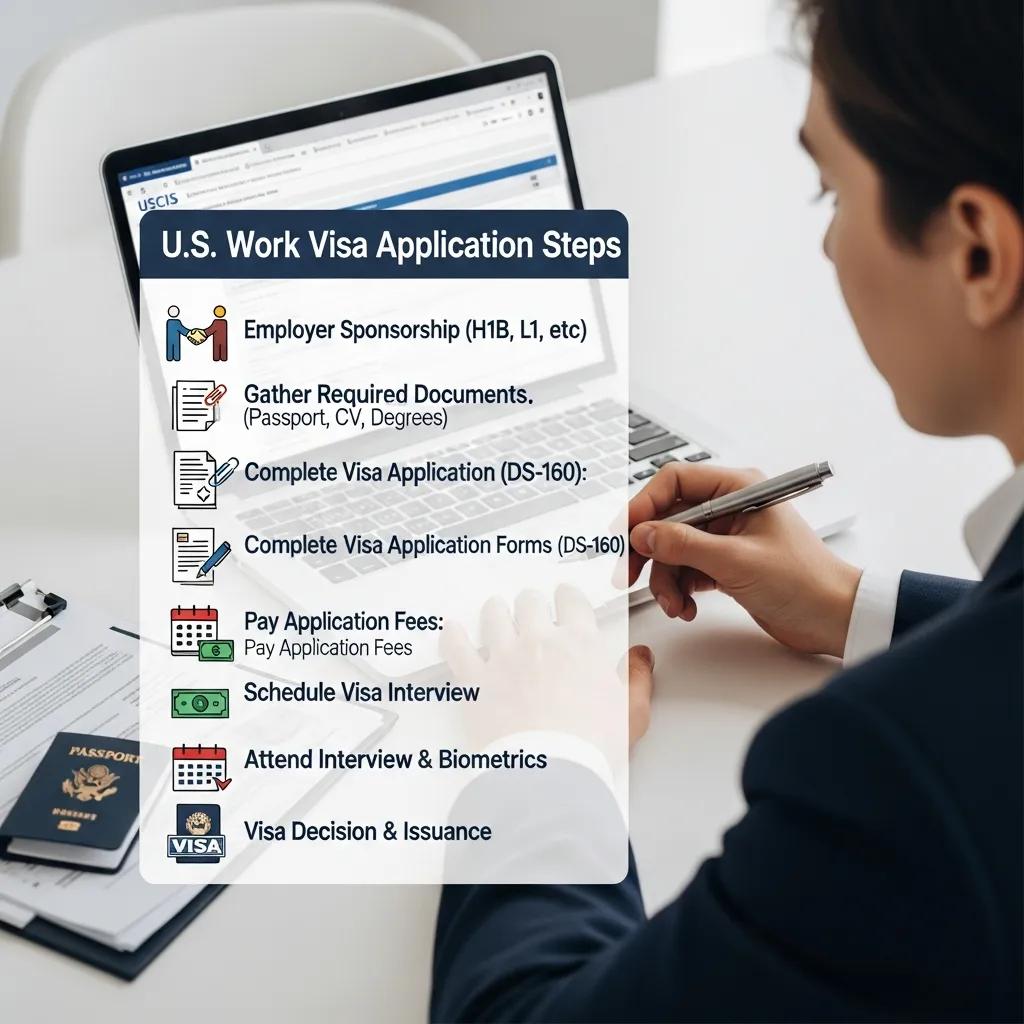
Application steps vary by visa type, but common milestones include petition filing, documentation gathering, possible labor certification, visa issuance, and arrival in the U.S. Timelines and exact procedures depend on the specific category and whether you apply from inside or outside the United States.
What Are the Employer Sponsorship and Labor Certification Requirements?
Many work visas require an employer to sponsor the foreign worker by filing a petition with USCIS. Where labor certification is necessary, the employer must demonstrate there are no qualified U.S. workers for the role, usually through a recruitment process and submission of an LCA to the Department of Labor.
How Long Do Visa Caps, Processing Times, and Appeals Typically Take?
Caps and processing times can affect your timeline. For example, H-1B petitions are subject to an annual cap and are generally filed during a specific window beginning in early April. Processing ranges from weeks to months depending on the visa, USCIS workload, and the applicant’s country of origin. If a petition is denied, you may have options to appeal or file motions to reopen or reconsider, which can extend the process.
How Can You Choose the Right Work Visa for Your Situation?
Choosing the right visa requires matching your qualifications, the job offer, and your long-term goals to the visa’s purpose and requirements.
What Are the Key Differences Between Temporary and Permanent Work Visas?
Temporary visas authorize limited-duration employment and often require employer sponsorship; some are capped each year. Permanent visas aim to provide ongoing residency and typically involve more steps, like labor certification and priority date tracking. Your career plans and family goals usually determine which route makes sense.
Which Work Visa Fits Common Professional Profiles?
Different professions tend to align with particular visas. IT and technical roles often fit H-1B. Multinational executives and managers may qualify for L-1. Healthcare professionals and advanced-degree holders frequently pursue EB-2, with NIW as an option for those whose work serves national interests.
What Common Challenges Arise in Work Visa Applications and How Can Gorostiaga Law Firm Assist?
The application process can present hurdles: complex documentation, strict timelines, visa caps, and nuanced eligibility requirements. Missing paperwork or missteps can cause delays or denials. Ready to discuss your case? Contact us today.
How Does Gorostiaga Law Firm Support Clients Through Complex Visa Processes?
Gorostiaga Law Firm, PLLC focuses on business immigration and guides clients through each stage of the visa process. Our multilingual team (English, Spanish, Portuguese, Hindi, Gujarati) provides personalized strategies that reflect your circumstances and helps you avoid common pitfalls, including complex areas like asylum and refugee law and DACA.
What Are Typical Issues with Visa Caps and Documentation?
Frequently encountered issues include hitting annual visa caps, incomplete or inconsistent documentation, and missed filing windows. Gorostiaga Law Firm helps clients assemble accurate files, track deadlines, and choose the most appropriate filing strategy to improve the chance of a favorable outcome. Learn more about our team and approach.
Frequently Asked Questions
What is the difference between a work visa and a green card?
A work visa allows temporary employment in the U.S. for a specified employer and period. A green card grants permanent residency and unrestricted work authorization, and can be a path to U.S. citizenship and naturalization. Visas usually require employer sponsorship and have specific limits; green cards can come from employment, family ties, investment, or other qualified categories. Your long-term plans determine which path is right.
Can I change employers while on a work visa?
Yes, but most work visas are employer-specific. Changing employers typically requires the new employer to file a petition on your behalf. For example, an H-1B transfer involves a new petition and usually a new LCA. Consult an immigration attorney before switching to ensure your status remains protected.
What happens if my work visa application is denied?
If an application is denied you'll receive a notice explaining the reasons. Depending on the case, you may be able to appeal, file a motion to reopen, or submit a new application with corrected or additional evidence. Reviewing the denial with an attorney helps identify the best next steps.
Are there any work visas for entrepreneurs or self-employed individuals?
Yes. Options include the E-2 Treaty Investor visa (for nationals of qualifying treaty countries who make a substantial investment and run a business) and the EB-5 Immigrant Investor Program (which leads to permanent residency with a qualifying investment that creates jobs). Each has specific requirements and suitability depends on your nationality and business plan.
How can I expedite my work visa application?
Some visas offer premium processing for an additional fee (for example, certain H-1B petitions), which yields a faster USCIS response—typically within 15 calendar days. Beyond that, submitting a complete, well-documented petition is the best way to avoid delays. An attorney can advise whether premium processing or another strategy applies to your case.
What are the consequences of overstaying a work visa?
Overstaying can have serious consequences. Staying more than 180 days but less than one year can trigger a three-year bar from re-entry; overstaying more than one year can lead to a ten-year bar. It’s important to maintain lawful status and seek legal help if you’re at risk of overstaying.